Why Creators Are Running 7 Apps to Do One Job — And What That's Costing Them
Open a creator's phone right now. Not their highlight reel, not their stats dashboard — their actual phone. What you will find is a collection of apps that have nothing to do with each other, all running in parallel, all demanding attention, all storing a piece of who that creator is and what they have built.
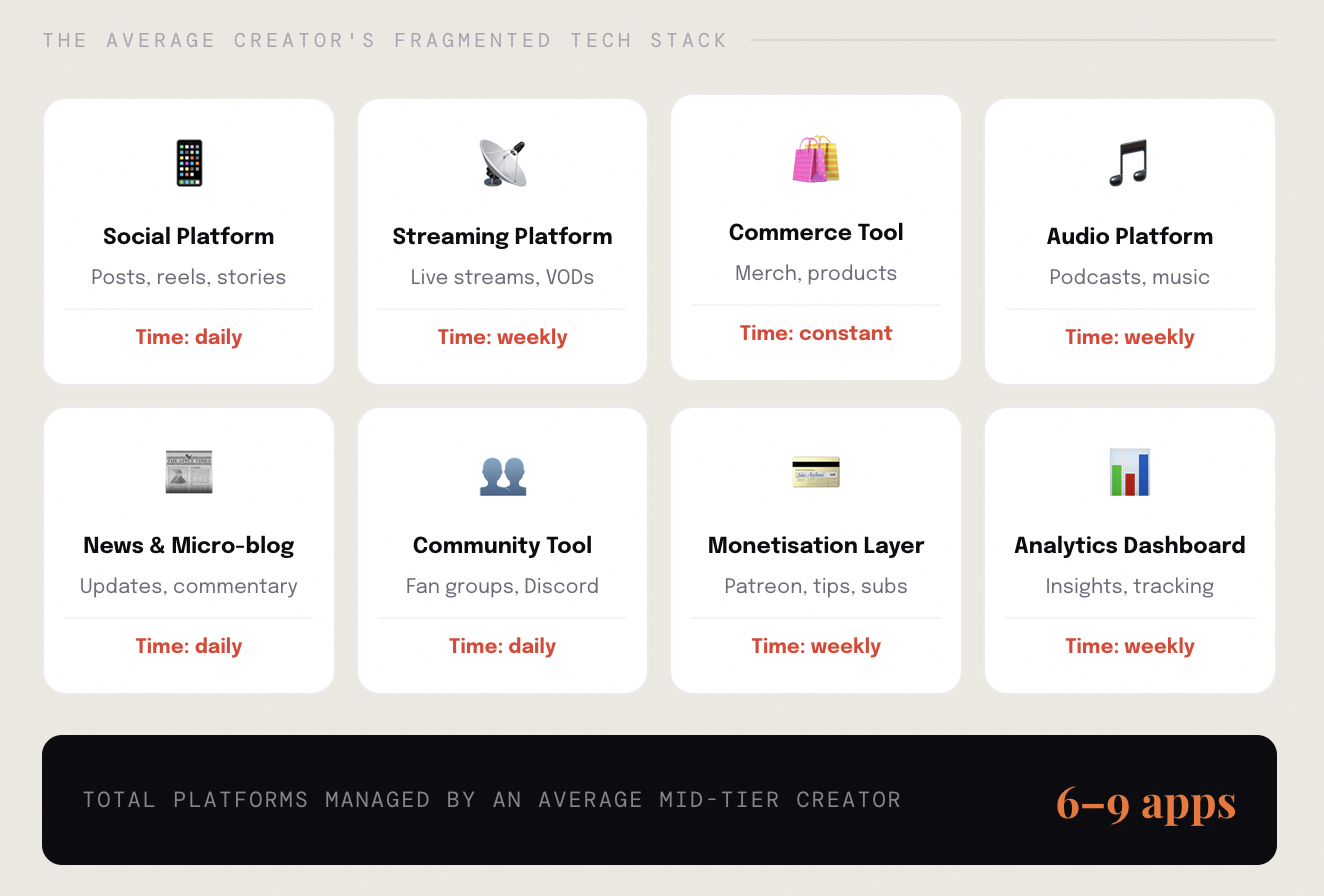
One app for the social feed. Another for live streaming. A third for selling merchandise. A fourth for distributing podcasts. A fifth for news and commentary. A sixth for connecting with their community. A seventh for tracking it all.
Seven apps. One creator. One job: make something people care about.
The fragmentation of the creator tech stack is not a minor inconvenience. It is one of the most significant — and most overlooked — drains on creative energy, time, and income in the modern creator economy. And the industry has been so busy building individual tools that nobody has stopped to ask what all of these tools are doing to the people who use them.
The Hidden Cost of Switching
There is a concept in cognitive psychology called context switching cost — the mental overhead incurred when you move from one task, tool, or environment to another. Every time you switch, your brain doesn't simply press pause on what it was doing and resume where it left off. It has to rebuild context. Re-engage with a different interface, different rules, different expectations.
For knowledge workers, research consistently shows that context switching can consume up to 40% of productive time. For creators — whose work depends not just on task completion but on creative flow, emotional engagement, and authentic expression — the cost is arguably higher.
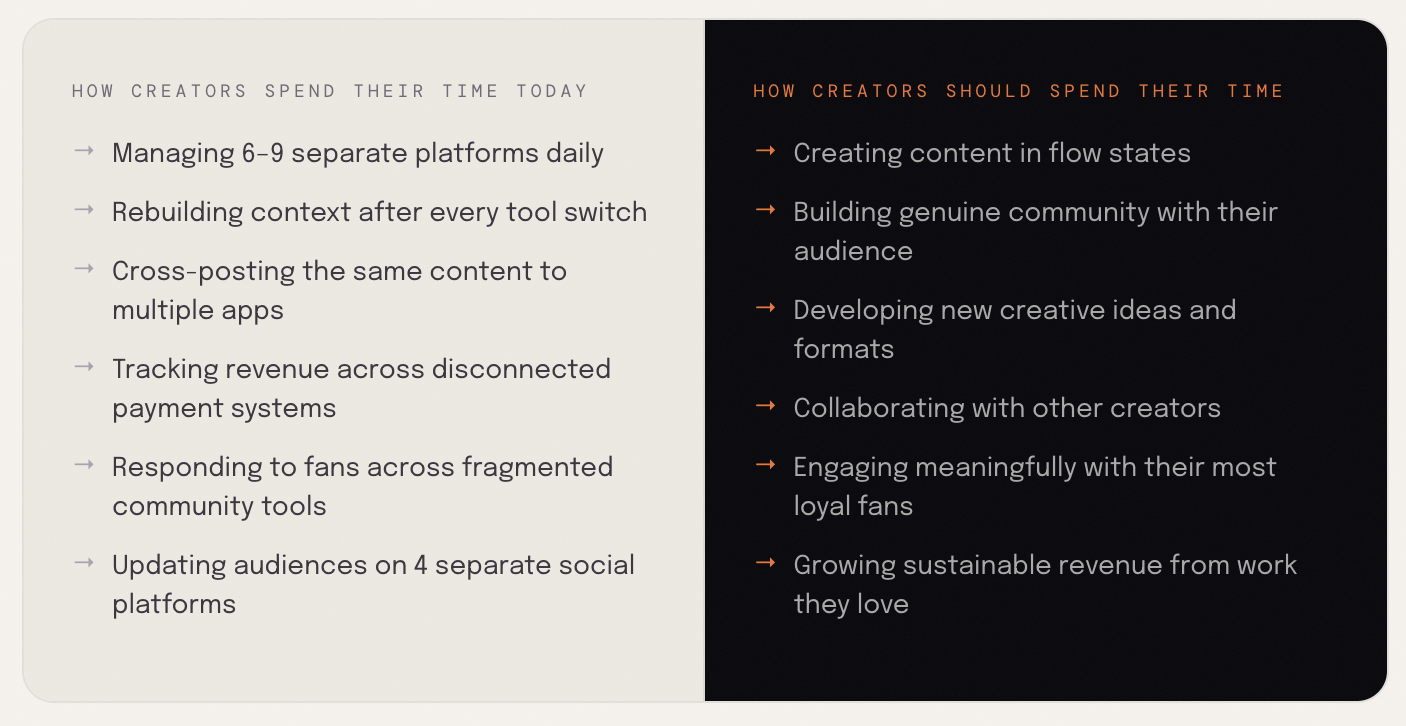
Every time a creator leaves their content creation environment to check their merchandise orders, respond to a community post on a separate platform, review their streaming analytics, or answer a support email from a subscriber on yet another tool — they are not just losing minutes. They are losing the mental and creative state that makes their work worth watching in the first place.
The irony is that creators adopted all of these separate tools in pursuit of better outcomes — more reach, more revenue, more connection with their audience. But the aggregate effect of running a multi-platform creative business is that creators spend less time creating and more time managing. The tools designed to help them scale have, paradoxically, made the act of creating harder.
The Audience Is Fragmented Too
The platform fragmentation problem does not live only on the creator's side. It lives equally in the experience of their audience.
Consider what it means to be a genuine fan of a creator in 2026. To follow someone comprehensively — to not miss things, to stay close to what they are building and saying — you need to follow them on multiple platforms simultaneously. Their Instagram for the daily visual content. Their Twitch or YouTube for the live streams. Their Spotify for the podcast. Their Twitter or Threads for the real-time commentary. Their Patreon or Substack for the paid content. Their Discord for the community.
Most fans don't do all of this. They can't. The friction is too high. So they follow creators partially — catching some of the content, missing the rest. The relationship between creator and fan is always thinner than it should be, because the infrastructure that should connect them is scattered across platforms that were designed to compete with each other, not integrate with each other.
This has a direct economic consequence for creators. When a fan only follows a creator on one or two platforms, they only see a fraction of what the creator produces. They miss product drops. They miss live sessions. They miss the podcast episode that would have converted them from a casual follower into a paying supporter. Fragmented discovery means fragmented revenue — not because the creator isn't producing valuable content, but because the infrastructure for delivering it to the people who want it is broken.
What Platforms Got Wrong
The existing platform landscape was not designed with creators in mind. It was designed with advertisers in mind.
The major social platforms built their business models around one equation: acquire as many users as possible, maximise the time those users spend on the platform, and sell that attention to advertisers. Creators were not the customers in this model. They were the content — the unpaid labour that kept users on the platform long enough to show them ads.
This original sin of the platform economy explains almost everything about why the current landscape is the way it is. It explains why creator monetisation was bolted on as an afterthought rather than designed as a core feature. It explains why analytics are optimised for advertiser decision-making rather than creator business intelligence. It explains why the community tools are designed to keep users inside the platform rather than to genuinely connect them with the creators they care about.The Three Things Every Creator Actually Needs
Strip away the noise — the features, the analytics, the growth hacks — and every creator needs exactly three things from their platform infrastructure.
1. A way to reach their audience
Not an algorithm that decides who sees what. Not a feed that buries posts unless you pay for promotion. A reliable, direct, meaningful connection between a creator and the people who have chosen to follow them. Push notifications to followers when you go live. Feed placement for people who have explicitly said they want to see your content. Community tools that allow genuine conversation rather than performative engagement.
2. A way to earn from their work
Not a revenue share that requires ten million views to produce a living wage. Not an opaque algorithm that can change overnight and erase months of income. Direct, transparent, immediate earnings from the people who value what a creator makes — through tipping, through pay-per-view content, through merchandise, through live event access. Every transaction settled instantly. Every payout transparent and available on demand.
3. A single place to do both
This is the one that the current platform landscape has failed to deliver. A creator should not need a social app for reach and a separate commerce app for revenue and a third community app for connection and a fourth analytics app to understand whether any of it is working. These things should live together — because they are not separate activities. They are different expressions of the same act: a creator building a relationship with an audience over time.
What a Unified Platform Actually Changes
When a creator's social feed, live stream, news content, podcast, merchandise store, and fan community all live in one place — with one audience who doesn't have to follow them across five platforms to stay close — something fundamentally changes about the creator-fan relationship.
Fans don't miss things. A follower who would have never found the creator's pay-per-view stream on a separate streaming platform sees it in the same feed where they already follow the creator's daily posts. A fan who would have never bought merchandise because they never saw the product drop is notified directly through the app they're already using. The creator's entire output is visible to their entire audience, all the time.
Creators don't split themselves. Instead of maintaining five different presences — each with its own analytics, its own community norms, its own algorithm to understand and appease — a creator builds one audience in one place. Their energy goes into creating rather than managing. Their creative voice stays consistent rather than being optimised separately for each platform's preferences.
And the economics change. When every touchpoint — content, community, commerce, and live experience — is connected through a single credits-based wallet system, a creator earns from every aspect of what they do rather than from whichever single platform happens to have the best monetisation deal this quarter.
This is what a creator-first platform actually looks like. Not a feature list. Not a monetisation policy. A structural rethinking of where a creator's work and their audience live — and a conviction that they should live together.
The Creator Economy Is at an Inflection Point
The creator economy grew up inside platforms that were not built for it. It thrived in spite of those platforms, through the resilience and creativity of the people who built audiences within systems that were designed for other purposes.
But that era is ending. Creators are increasingly aware of the cost of platform dependence — algorithmic volatility, opaque monetisation, audience fragmentation, and the psychological toll of managing a creative career across infrastructure that was never designed to support one.
The next phase of the creator economy will be defined by platforms that are built specifically and exclusively for creators and their communities. Platforms where the economics are aligned — where the platform succeeds when creators succeed, not when advertisers spend. Platforms where community and commerce are the same thing, not separate departments.
That shift is already happening. And the creators who find their way to unified, creator-first platforms now — before the migration becomes obvious to everyone — will have built something durable by the time the rest of the market catches up.
Seven apps. One job. The math has never made sense. It's time for something different.
Try JaroGO
One app. Every creator need.
Join creators and fans already building on JaroGO — the platform where content, community, and commerce finally live together.