
Social Media Promised Us Connection. What We Got Instead Was an Audience.
Think about what the early days felt like. Before the algorithms, before the follower counts, before the engagement dashboards. A friend posted a photo from a city you had never visited. A stranger shared a thought that made you feel less alone. A musician uploaded a song recorded in their bedroom that found someone who needed to hear exactly that, on exactly that day.
That was connection. Messy, unoptimised, algorithmically unranked. And it was what social media, at its best, actually was.
How the Feed Became a Stage
The shift did not happen overnight. It happened through thousands of small product decisions that each made rational sense in isolation — and together built a system designed not to facilitate connection, but to maximise time on platform.
The introduction of the public like count was one of the earliest and most consequential. Suddenly every post had a visible score. And scores change behaviour. When your words come with a number attached — visible to everyone, including yourself — you begin, consciously or not, to optimise for the number rather than for the truth.
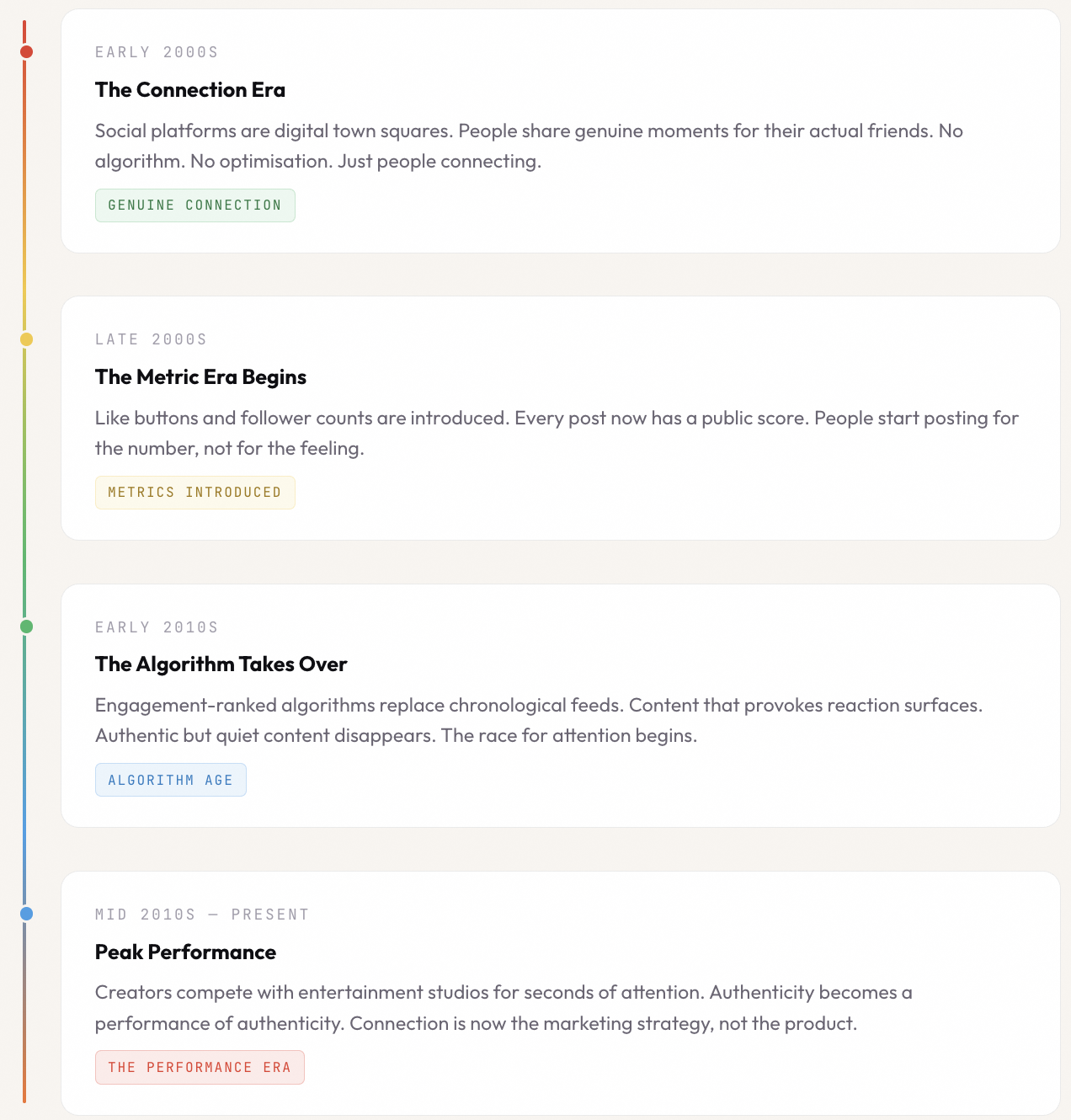
You were not rewarded for being real. You were rewarded for being engaging. And real and engaging, it turns out, are not the same thing.
What the Algorithm Replaced
The move from connection platform to performance stage did not just change the content. It changed the relationship between creators and the people who followed them.
For creators, the consequences went deeper than aesthetics. The algorithm teaches a corrosive lesson: be less yourself, be more of what the numbers reward. A musician who shares the vulnerable 2am demo and watches it disappear — then shares a trend-chasing production and watches the numbers move — learns, over time, to stop sharing the honest thing.
Fans lost something too. When algorithms replaced chronological feeds, followers stopped seeing what creators actually posted — they saw what the platform decided they should see. The genuine proximity between a creator and the people who chose to follow them was replaced by a ranking system that neither side controls.
What Real Connection Actually Looks Like
If the performance model broke connection, what does genuine online connection actually require?
It requires continuity — the sense that the relationship persists across time and contexts, not just in the thirty seconds before an algorithm surfaces something else. It requires participation — the ability to affect what happens, not just observe it. The fan whose question gets answered on camera. The community member whose idea shapes what the creator does next. And it requires economic directness — the sense that supporting a creator actually enables that creator to keep creating, not feeds an ad ecosystem that treats both sides as inventory.
The creators who have built sustainable careers on social media have done so not by winning the algorithmic game but by building genuine communities — groups of people who return not because an algorithm surfaced content at them, but because something in the creator's work resonated deeply enough that they came back on their own.
Virality gives you an audience. Consistency gives you a community. Only one of those will still be there when the algorithm changes.
Building It Somewhere Better
Social media promised us connection. Most platforms delivered performance infrastructure instead. But the appetite for the original promise — genuine, direct, sustained connection between creators and the people who care about their work — never went away. It just went looking for somewhere better to live.
That is exactly what JaroGO was built for.
On JaroGO, a creator's social feed, live stream, news content, podcast, and merchandise store all live in one place — with one audience, one community, and one wallet that lets fans support creators directly. There is no algorithm deciding which followers see which posts. No ad model treats your audience as a product to be sold. When a fan tips a creator during a live stream, that credit goes to the creator. When a fan buys from a creator's store, the creator earns. The relationship between creator and fan is direct, transparent, and sustainable — by design.
JaroGO is not a social platform trying to be more. It is what social platforms were supposed to be before the algorithm replaced the relationship. A place where creators create because they love what they make, where fans follow because they genuinely care, and where the infrastructure between them is built to bring them closer — not to keep them scrolling.
Connection was always the point. We just built the platform to prove it.
Join JaroGO!!
Connection, not performance.
Community, not just followers.
JaroGO is built for creators who want genuine relationships with their audience — not just numbers on a dashboard.